Showing posts with label Open Source. Show all posts

2018/11/21

How i discovered Nuxeo Docker Scaling


ECM is dead - Let me introduce you to this really good Content Service Platform: Nuxeo.

What i first noticed in Nuxeo Platform is its Cloud Ready architecture. It comes ready to use on AWS and it scales like described on the schema bellow.
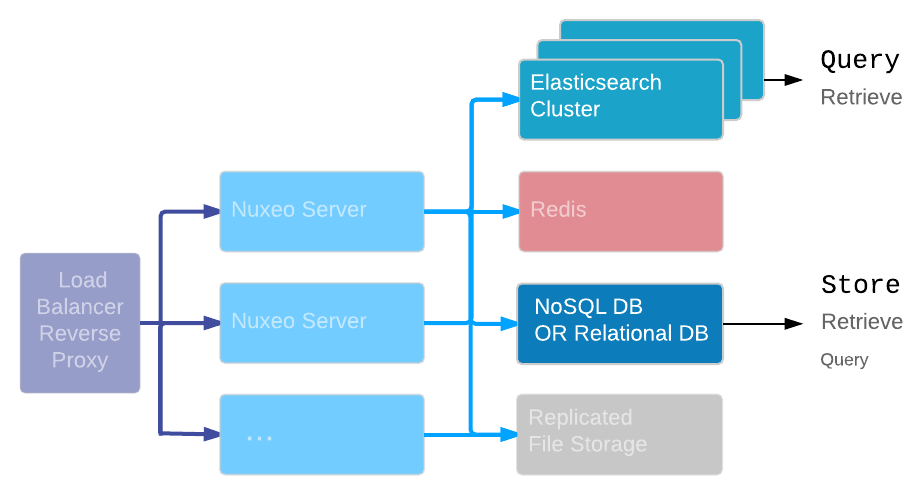
To me, scalability means :

  1. no bottleneck
  2. modularity and extensibility

So far, i've experimented and checked :

1. DB agnostic and how simple it is to change from Postgres (SQL) to MongoDB (No SQL) for exemple. Brilliant ! My docker exemple is below with Mongo, but i also tested with Postgres and it really is as simple as edit a nuxeo.conf file. As DevOps, i can imagine it could should be a very useful pattern;
Modularity + 1

2. I started with the official Nuxeo Docker image. Then using docker-compose, i easily split my Nuxeo Project in one Nuxeo Server, one Elasticsearch and one Mongo. And later, it's possible to create an Elacticsearch node and clusterize Nuxeo Server too (as worker for asynchronous jobs) - again, a very useful pattern if you need to adjust your search or frontend performances; 
Modularity + 1

3. In general, performance and load distribution is difficult to test and measure. Nuxeo did their own benchmarks, but i wanted to make sure that nodes and specially the Nuxeo Server is ready to handle a huge web traffic. So i built a small Node js client based on nuxeo-js-client and tried to load test my Nuxeo Dockerized Platform (Nuxeo Server + Elastic + Mongo). I used Cadvisor as a monitoring tool. Here are the result I got:

Scenario 1, In one minute, more than 3 000 requests (read, update and create). CPU usage went up and fell down for all nodes similarly. Memory looks stable, no big peak. No real stress (10 ms request average).

windows (left to right) : Node js, Nuxeo, Elastic, Mongo.


Scenario 2, In two minutes, more than 12 000 requests (read, update and create), and then what i wanted to see: Memory following the speed-up ramp but CPU is staying moderate (compare to other scenarios) - other nodes receiving a continuous charge from Nuxeo Server Node. Is Nuxeo is dealing with memory to ramp up? yes, it allocates more memory to deal with the increase traffic, a good choice, specially in a Cloud context... but, most important here: 300 mixed reqs / sec - works like a charm! And Im pretty confident that it could handle more (regarding my config, docker, laptop etc...).

Notice : Nuxeo memory ramp-up, and what it looks like an Elasticsearch indexing in the middle - cool :)


Well done (30 ms request average) ! "No bottleneck" +1

I definitely need to go further, maybe in another post ? How and Elasticsearch is indexing all new contents ? Clustering ?...
But if you're interested in subject, the docs are here https://doc.nuxeo.com/nxdoc/nuxeo-cluster-scalability-options.

My Node Client, and Docker Gist, if you want to make your opinion :

Enjoy
@Mat

2011/02/28

[Fr][Techs] SI Libre ?

Le logiciel libre, ou “le logiciel pour tous” est une bonne initiative. Forcement.

Bon, j’avoue l’Open Source me plait ! Mon romantisme me perdra peut être, mais en réalité, qui pourrait conspuer la mutualisation, la réutilisation et la liberté d’utilisation d’un produit aujourd’hui ?


Ensuite, la question qui se pose est : “combien cela me coûte?” ou un peu différent “combien cela va me rapporter ?”. Une société qui franchit le pas vers un SI plus Libre, admet qu’elle s’ouvre un peu plus, en réduisant les coûts, mais garde ceux incompressibles de la mise en place, la formation, les prestations de conseil associés... 

L’avenir nous dira si les sociétés feront le choix de la communauté ?
Car c’est malin et ca peut marcher ?! … Bon, je fais de la pub pour OpenBravo :

"For the first time, Openbravo ERP has allowed us to have an operation that is 100% integrated and efficient. We now have a single source of information for effective decision making."
Juan Antonio de La Rosa, COO, Lumiméxico
"Open source enterprise applications have a bright future. Its customization capabilities and its total cost of ownership are more suitable for SMB needs."
Christian Rey, Innovation Managing Director, Marseille Innovation


Le tableau suivant (qui date un peu) récapitule les fonctionnalités principales des ERP Open Source :


Voici la liste des principaux progiciels:
  • Compiere
  • Aria
  • OpenBravo (fork de Compiere)
  • ERP5, édité par la société Nexedi
  • TiOlive, édité par la société TiOlive, filiale de Nexedi
  • Fisterra
  • OFBiz (Open for Business)
  • PGI Suite 
  •  Tiny ERP (OpenERP) : Un Progiciel de Gestion Intégré (PGI/ERP) qui couvre tous les domaines de l’entreprise, s’adaptant aussi bien aux petites, moyennes et grandes entreprises - Bon retours.

Mais aussi, en version plus légère, PHP pour la plupart :
  • Dolibarr : un ERP/CRM complet et libre - Testé et approuvé.
  • EGGcrm : Gestion de la Relation Client (CRM en anglais) : optimiser et simplifier la gestion commerciale de votre entreprise
  • Laurux : Gérez votre entreprise : comptabilité, ventes, inventaires, etc.
  • Neogia : Un PGI libre et multi-plate forme
  • OBM : est une solution de messagerie collaborative simple au design "web 2.0" qui propose en plus des fonctionnalités de CRM et de gestion de projet
  • OpenAguila : Un logiciel de gestion d’entreprise (PGI) destiné aux TPE/PME
  • OpenBlueLab un ERP & CRM Open Source, évolutif, basé sur une architecture de plugins
  • OpenPLM Outil de Gestion de Cycle de vie de Produit
  • vtiger CRM un CRM

A vous de jouer ;) !

2010/03/12

[En][Techs] +33% for the GPL and Open Source during 2009

Regarding the latest study on the subject, P.Audoin Consultants shows that 2009 has not been a whole year of crisis for the OSS, both in France and European level.

What about big software compagnies ?... ;)

Source : toolinux.com