Showing posts with label Civic. Show all posts

2025/05/04

How We Faced Digital Exile: When Machines Decide Our Human Worth

Human silhouette behind digital bars

It began like any other day. Login screen. Password. Click. But instead of the familiar feed of connections and opportunities, a cold message greeted us: Account restricted. No warning, no clear explanation—just digital exile from LinkedIn, a platform that had become essential for sharing our innovations with the world.

My colleagues found ourselves branded as "unverified" by unseen algorithms. What does it mean to be "unverified" in a digital world? To have your digital existence questioned, your professional identity suspended by automated systems operating on logic we cannot fully comprehend?

Let's face this philosophical challenge :)

The Kafka-esque Nightmare

Franz Kafka once wrote: "Every revolution evaporates and leaves behind only the slime of a new bureaucracy." Perhaps the digital revolution is no different, except now the bureaucracy isn't staffed by disinterested civil servants but by lines of code—efficient, unfeeling, and operating at a scale that makes individual appeals seem futile.

Our attempts to resolve the situation felt like shouting into a void. Form submissions disappeared into digital ether. Automated responses offered vague explanations about "community guidelines" without specifying which ones we had violated. The lack of human contact was the most jarring aspect—no eyes to look into, no ears to hear our frustration.

The Philosophical Dimensions

This experience transcends mere inconvenience. It touches on fundamental questions about our relationship with technology and our place in an increasingly automated society.

Michel Foucault might view this as a new form of discipline and control: "There is no need for arms, physical violence, material constraints. Just a gaze. An inspecting gaze, a gaze which each individual under its weight will end by interiorizing to the point that he is his own overseer, each individual thus exercising this surveillance over, and against, himself." The modern digital panopticon doesn't need walls—it has terms of service agreements and community guidelines that we enforce upon ourselves, living in fear of transgression.

Jean Baudrillard would likely see our predicament as evidence of simulation overtaking reality: "The simulacrum is never that which conceals the truth—it is the truth which conceals that there is none. The simulacrum is true." Our professional identities, reduced to profiles and verification badges, become more "real" in the digital economy than our flesh-and-blood existence and actual accomplishments.

The Human Cost

Beyond philosophical musings lies a tangible impact. Innovation stifled. Connections severed. Opportunities missed. The algorithms that banned us don't calculate these costs. They can't quantify the frustration of explaining to partners why we've suddenly disappeared from the platform, or the effort of rebuilding digital credibility from scratch.

Simone Weil once wrote: "To be rooted is perhaps the most important and least recognized need of the human soul." Digital platforms have become new soil in which we root our professional identities. To be uprooted by automated decision-making creates a unique form of modern alienation.

Finding Meaning in Digital Exile

Albert Camus might suggest embracing the absurdity: "In the midst of winter, I found there was, within me, an invincible summer." Perhaps there's freedom in recognizing the capriciousness of digital existence. If our online presence can be erased or restricted on a whim, maybe we should build more resilient networks—ones that don't collapse when a single platform decides we don't meet its invisible criteria.

Hannah Arendt reminds us: "The sad truth is that most evil is done by people who never make up their minds to be good or evil." The systems that banned us weren't malicious—they were indifferent, which in some ways feels worse. No one decided we should be banned; a system simply executed its programming without concern for nuance or consequence.

Moving Forward

As we navigate this bizarre experience, I'm reminded of Nietzsche's words: "That which does not kill us, makes us stronger." This digital setback has forced us to reconsider how we share our innovations, how we connect with others, and how much power we're willing to cede to platforms we don't control.

Perhaps the most profound lesson is one of digital fragility. Our online existences—carefully curated, professionally valuable—rest upon foundations we don't own, governed by rules that shift like sand.

Martin Heidegger wrote: "The question concerning technology is never a technological one." Indeed, our experience shows that questions about technology quickly become questions about power, identity, truth, and what it means to be human in an increasingly automated world.

As we work to resolve our situation with LinkedIn (or explore alternatives), I carry these reflections with me. The machines may temporarily deny our digital existence, but they cannot diminish our human creativity, resilience, and capacity to find meaning even in algorithmic absurdity.

2025/03/25

How I Discovered Altruism Can Match Business


In the cutthroat world of business, where profit often seems to be the only measure of success, I recently discovered an inspiring counter-narrative through the remarkable story of Kazuo Inamori. His journey has fundamentally challenged my understanding of how business and altruism can not only coexist but thrive together.

The Revelation: Altruism as a Business Force

Kazuo Inamori, the founder of Kyocera and savior of Japan Airlines (JAL), built his business empire on a foundation that might seem counterintuitive to many: altruism. His philosophy centers on the belief that business decisions should be made with an altruistic mindset, considering the benefit to others rather than personal gain.

What's remarkable is that this isn't just idealistic thinking - it's proven to work. Under Inamori's leadership, Kyocera grew from a small ceramics company into a global technology corporation. Perhaps even more impressively, he led the turnaround of JAL from bankruptcy to profitability in just three years, all while maintaining his commitment to altruistic management principles.

The Power of Altruistic Decision-Making

Inamori's philosophy teaches us that when we make decisions with an altruistic mind, we create what he calls a "virtuous circle." While it might be human nature to put ourselves first, focusing solely on personal gain often leads to short-term thinking and ultimately unsustainable success. In contrast, when we consider how our actions benefit others - employees, customers, society - we build lasting value that returns to benefit everyone involved.

My Personal Challenge

As I reflect on Inamori's teachings, I've begun to challenge myself to apply these principles in my own business practices. It's not always easy - the pressure to prioritize immediate profits is real. However, I'm learning to ask different questions when making decisions:

  • How does this decision benefit our customers beyond just our bottom line?
  • What value are we creating for society?
  • Are we building sustainable, long-term relationships rather than chasing quick wins?

This journey has led me to realize that business success and altruism aren't mutually exclusive - they're mutually reinforcing. When we make decisions that genuinely benefit others, we often find that success follows naturally.

The Challenge to You

I invite you to join me in this exploration of altruistic business practices. Consider how you might incorporate these principles into your own work:

  1. Before making important decisions, pause to consider their impact on all stakeholders, not just shareholders
  2. Look for opportunities to create value for others, even when the immediate benefit to you isn't clear
  3. Build relationships and trust through genuine concern for others' success

For more inspiration, I recommend watching Kazuo Inamori's conference talks on YouTube, where he eloquently explains how this philosophy has guided his remarkable success. His message is clear: when we lead with altruism, we create sustainable success that benefits everyone.

As I continue on this path, I'm discovering that the question isn't whether altruism can match business - it's whether we can afford to do business any other way.

2024/12/31

How to link Altruism and Business


If you are located in the northern hemisphere, this time of year is a perfect period for reflection. (southern hemisphere's welcome too).

And if I can share the most inspiring thing I have seen in 2024, it is Kazuo Inamori's position: linking hashtagAltruism and Business.

What beautiful things to purify your intentions, be altruistic and build balanced and respectful partnerships.

Kazuo Inamori has tried to do this all his long life https://www.youtube.com/watch?v=U5FRqyMEQUA 😍

=> I wish we can continue to do this with RadarToRain 😇
=> I wish you all to be able to do it in this coming new year #2025! ✊

Cheers ! 🙂 🥂

2017/06/06

Trust the General Yue


If you got a pill to get you healthy all your life ?

It exists ! originally created by Yue Fei (12th century General) : "Here comes theses exercises for a entire healthy life"...

What do you think ? :)
To me, as kung fu practising, no doubt that it's definitly relevant in our world, for everyone.

So please, trust the General Yue and try these 8 very simple exercices.

When you will be ready, healthy, and happy ... you can go further :)


2016/02/01

#JeSuisCharlie note to myself

Sad. Very sad.

After the emotional wave, note for myself : "what i've learned from this event"


For my kids 

I found that one indicator could be relevant : self laughing capacity
 .. as indicator that shows the amount pb you have to self resolve.

For myself

And this redundant question : "understanding" does(n't) it mean "being passive" ?

... forgive is not forget.


2014/12/29

Bonnes fêtes !


A vous tous ! :)
Et hop .. musique

2014/11/16

Why i'm veggie

So many people ask me (specially in France?!) when they see i don't eat meat or fish, "Mathieu, why are you veggie ?"

This post to answer them clearly, taking time to detail with videos and other referral links.

For a veggie audience, i'm sure all of this is obvious but because our personal priorities, let's explain mine...

Traditionally there a 3 major reasons to stop eating meat and to go down in the food scale.

1) health
Because so many studies explains the "too much" problem, like cancer risk.

2) ecology
Because producing an animal protein is too heavy;
Do we need 8 planets (vs 1 with vegetal proteins) ?


3) ethic n' compassion

"A society will be judged on the basis of how it treats its weakest members and among the most vulnerable are surely the unborn and the dying,"   ~Pope John Paul II

How could we called as "civilised society" when we're doing ... this :


For me it's the most important point, because we're talking about your conscious, our common conscious.
And the more we grow up, the more we will change for a better world.

Voila.
Some links :
http://www.vegetariantimes.com/article/why-go-veg-learn-about-becoming-a-vegetarian/
http://www.britishmeat.com/49.htm


2010/02/19

Pensée pour l'Afrique

Une petite pensée pour ce beau continent;
Et d'ailleurs ... c'est bientot la coupe du monde ?


2009/11/26

20 mn de plaisir .. et Copenhague ?

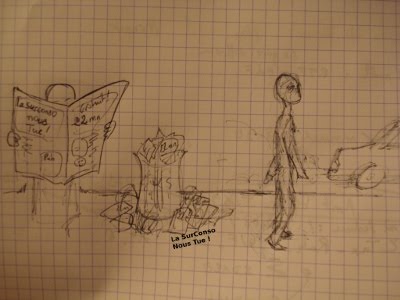
Un petit dessin coup de gueule contre les plaisirs jetables, la sur-consommation, la pollution, le "rapide".
La première des journaux ...sur le sommet de Copenhague ?
se jeter sur ces journaux gratuits .. .. .. se jeter ... prendre .. jeter

se calmer


2009/11/19

Foot Mondial

Ce petit dessin d'actualité ... mais attention j'aime toujours le foot !


Petite question que l'on m'a posée ... l'air de rien :
"T'aurais fait quoi à la place d'Henry ?" ...
- silence - O_o
Et oui, quelles sont les valeurs de ce monde ?
tricher en attendant un juge couperet qui n'est pas venu hier, ou être honnête ..
et Vous, vous auriez fait quoi ?

a+ mat

2009/07/13

Barack au Ghana


Moi j'aime l'Américain Comme çà !

2009/06/08

Pour une Europe Verte ?

16 pourcent

Franchement .. trop content